
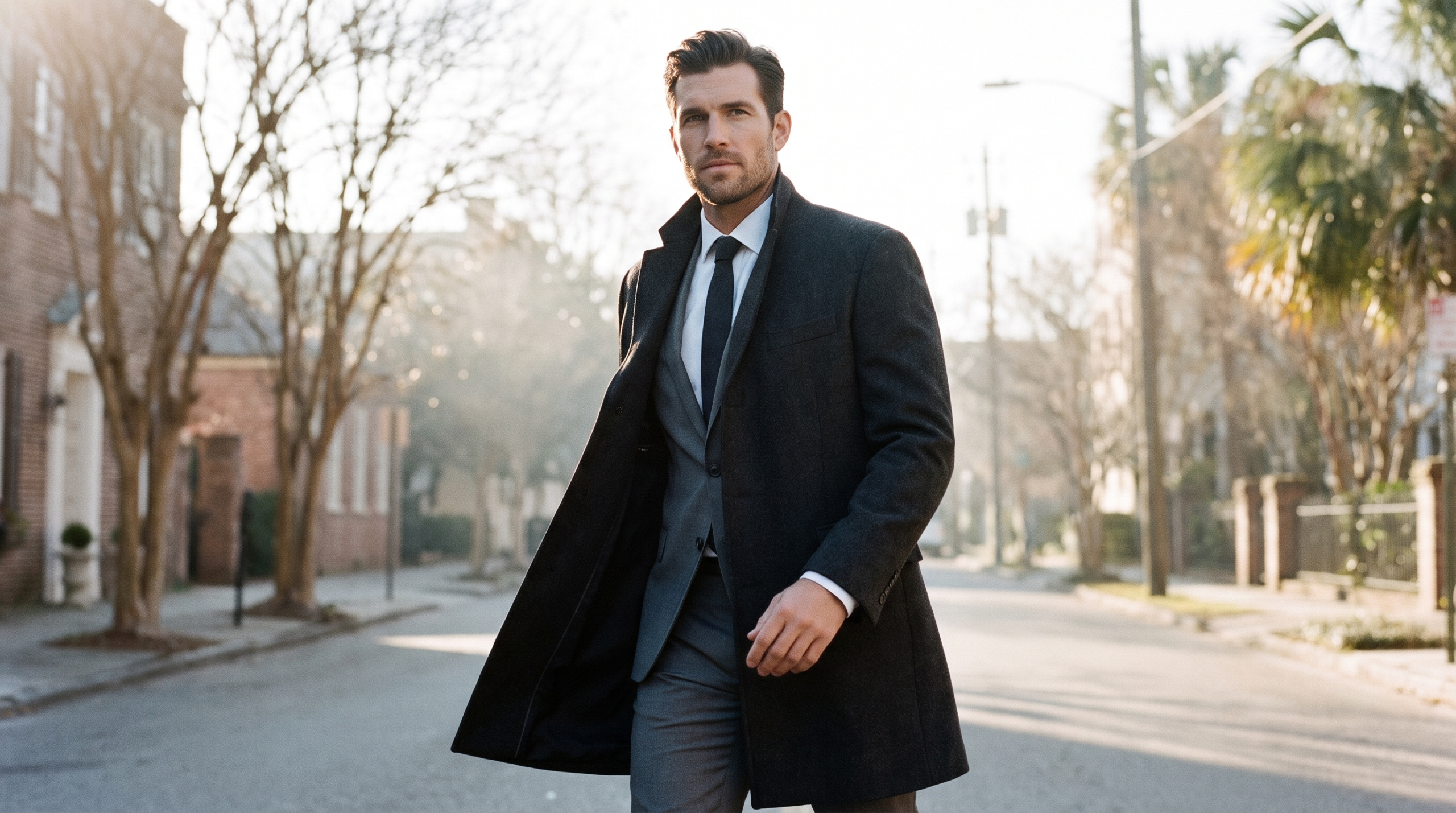

A coat worn over tailoring has to be cut for tailoring. It needs room through the chest and shoulder for the jacket underneath, and enough length that the jacket does not show below the hem.
This is where most outerwear fails. A casual jacket bought on its own fits the body. Pull it on over a suit and the shoulders bind, the chest pulls, and the suit jacket bunches underneath — which undoes the work the tailoring was doing in the first place.
A topcoat solves a specific problem, and it is cut accordingly.
Length
Mid-thigh
Car coat
The shortest length that still works over a suit. Easy in and out of a car, which is what it was named for. The limitation is that a longer suit jacket can show beneath the hem, so it suits shorter jacket lengths better.
Just above the knee
Topcoat
The most versatile length and the one we make most often. It covers the suit jacket completely, works over tailoring and over knitwear, and reads as formal without being severe. If you are buying one coat, this is it.
Below the knee
Overcoat
The traditional formal length, and the right choice over black tie or for genuinely cold climates. It carries real presence, and it asks for a certain amount of height to look balanced rather than engulfing.
Worth knowing. A coat should be measured over the jacket you will actually wear beneath it — not over a shirt. The difference is roughly two sizes in the chest and shoulder, and a coat fitted without the jacket present will be tight across the back the first time you use it properly.
Cloth
Coating cloth is heavier than suiting, typically 400 to 700 grams, and the weight is doing structural work as much as insulating. A light cloth will not hang properly at coat length; it moves rather than falls.
Cashmere and cashmere blends are the softest option and the warmest for their weight, with a quiet surface that suits a formal coat. Pure wool in a twill or herringbone is more robust and takes daily use better. Camel hair sits between the two and brings a distinctive colour that works where navy and charcoal feel predictable.
A note on Southern California
Nobody here needs a coat for survival, which changes what a coat is for. It is worn for evenings, for travel, and for the handful of weeks when the mornings genuinely bite — and it is seen far more often in photographs than it is needed for warmth.
That argues for a lighter cloth than a client in Chicago would choose. A topcoat in the lower half of the coating range handles a San Diego or Los Angeles winter comfortably and does not become unwearable the moment you step indoors. If you travel east regularly, a heavier cloth earns its keep; if you do not, it will mostly stay in the wardrobe.
The same reasoning that applies to suiting weight applies here, and it is covered in choosing fabric for a Southern California wedding.
Commissioning one
Custom top coats start at $1,400. Pricing depends primarily on your choice of cloth, with additional options affecting the final cost. Detail is on the pricing page.
A coat is a good second or third commission rather than a first. It is worn over everything else you own, so it makes more sense once the tailoring underneath is settled — and unlike a suit, it does not need to fit closely, which means it keeps working through modest changes in weight.
Bring the jacket you expect to wear under it to the first appointment. That one detail determines most of the pattern.
Bring the jacket you will wear underneath. The rest follows from it.
